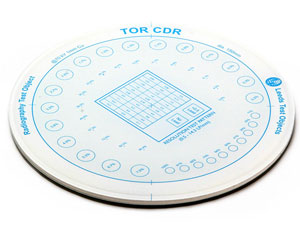
TOR CDR

TOR CDR radiography phantom is a routine test object designed to be used quickly and easily on a regular basis (e.g. weekly or monthly) to provide an ongoing check of imaging performance, particularly those aspects which are most liable to deterioration. After an initial grey-scale check, image quality is measured simply by counting the number of details detected and the number of bar-patterns resolved in the image. An ongoing record of these numbers will reveal any trend towards deterioration in imaging performance.

Used for conventional and non-subtractive digital radiography, and fluorography, enables the following checks to be made:

  • Sensitometric measurements (10 test point details, 5.6mm diameter)
  • Resolution limit (0.5 to 14.3 LP/mm)
  • Low-contrast large-detail detectability (17 details, 11mm diameter)
  • High-contrast small-detail detectability (17 details, 0.5mm diameter)

In addition to checking the consistency of radiographic performance, the test object can be used to assess the relative performance of different screen-film combinations.
SedentexCT IQ

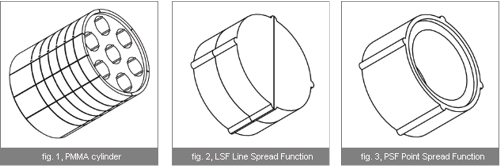
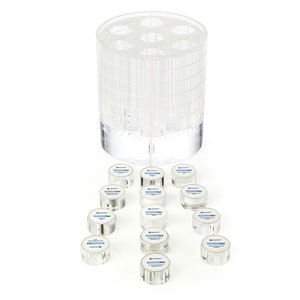
SedentexCTIQ consists of a PMMA cylinder (160 mm diameter) with recesses to house test inserts (fig. 1). Within the body of the cylinder are features for the following tests:

  • Noise/Uniformity
    The lower section of the phantom is uniform PMMA (density 1.20 +/- 1.00%)
  • Geometric Distortion
    An array of 2.0 mm diameter, 3.0 mm deep Air gaps are uniformally pitched at 10.0mm intervals through one slice of the cylinder

Test Inserts are included to perform the following measurements:

  • Spatial Resolution
    • Line Spread Function (LSF) – PMMA/PTFE interface (fig. 2)
    • Point Spread Function (PSF) – 0.25mm diameter stainless steel wire suspended in air (fig. 3)
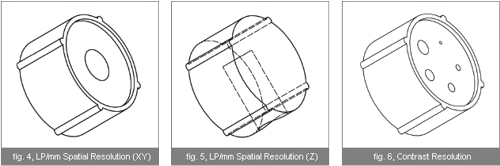
    • LP/mm – alternating Aluminium/polymer (XY)
      (1.0, 1.7, 2.0, 2.5, 2.8, 4.0 and 5.0 LP/mm) (fig. 4)
    • LP/mm – alternating Aluminium/polymer (Z)
      (1.0, 1.7, 2.0, 2.5, 2.8, 4.0 and 5.0 LP/mm) (fig. 5)
  • Contrast Resolution (fig. 6)
    1.0, 2.0, 3.0, 4.0, 5.0 mm diameter Al, PTFE, Delrin, LDPE and Air rods suspended in PMMA
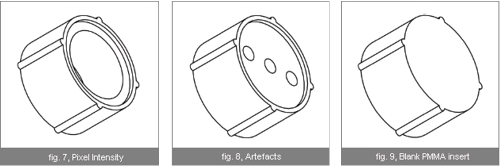
  • Pixel intensity (fig. 7)
    10.0 mm diameter Al, PTFE, Delrin, LDPE and Air rods suspended in PMMA
  • Beam Hardening Artefacts (fig. 8)
    A line of three 5.0 mm diameter rods of Ti suspended in PMMA
  • Blank PMMA insert (fig. 9)
  • Automatic Scoring Software (available separately)
    See Radia software for more details

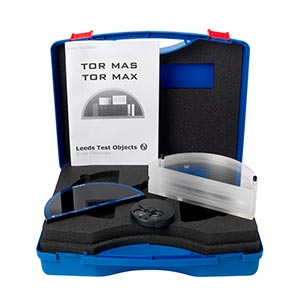
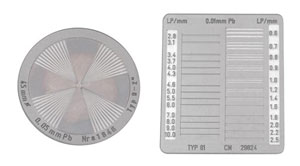
TOR MAS

A test object designed to be used quickly and easily on a routine basis to provide an ongoing check of imaging performance, particularly those aspects which are most liable to deterioration. An ongoing record of these numbers will reveal any trend towards deterioration in imaging performance.

The kit consists of:

  • TOR MAS test object
  • 7cm attenuator stack

Enables the following checks to be made:

  • Ten-step grey-scale plus two points for Sensitometric measurements.
  • Resolution limit (1.0 to 20.0 LP/mm) x 1
  • Low-contrast large-detail detectability (12 details, 5.6mm diameter)
  • High-contrast small-detail detectability (11 details, 0.5 and 0.25mm diameter)
  • Irregular-shaped particles on a step-wedge background (median sizes 125, 225, 325 microns representing micro-calcifications).
  • Low Contrast Resolution Pattern (1.8 to 5 line pairs/mm, representing filamentary structures).

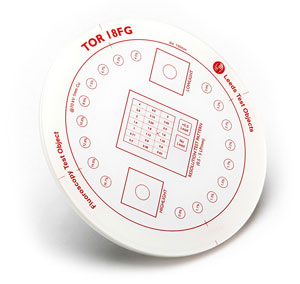
TOR 18FG

TOR 18FG fluoroscopy phantom is a routine test object designed to be used quickly and easily on a regular basis (e.g. weekly/monthly) to provide an ongoing check of imaging performance, particularly those aspects which are most liable to deterioration. After an initial grey-scale check, image quality is measured simply by counting the number of details detected and the number of bar-patterns resolved in the image. An ongoing record of these numbers will reveal any trend towards deterioration in imaging performance.

Used for fluoroscopy and fluorography, enables the following checks to be made:

  • Monitor brightness and contrast level adjustment (highlight and lowlight details)
  • Resolution limit (0.5 to 5.0 LP/mm)
  • Low-contrast large-detail detectability (18 details, 8mm diameter)
  • Circular Geometry (Lead Circle)

Small F.O.V. TOR 18FG

We can supply smaller diameter field of view versions of TOR 18FG on request, with the same features as the standard phantom (ideal for mini C-arms).

Skip to content